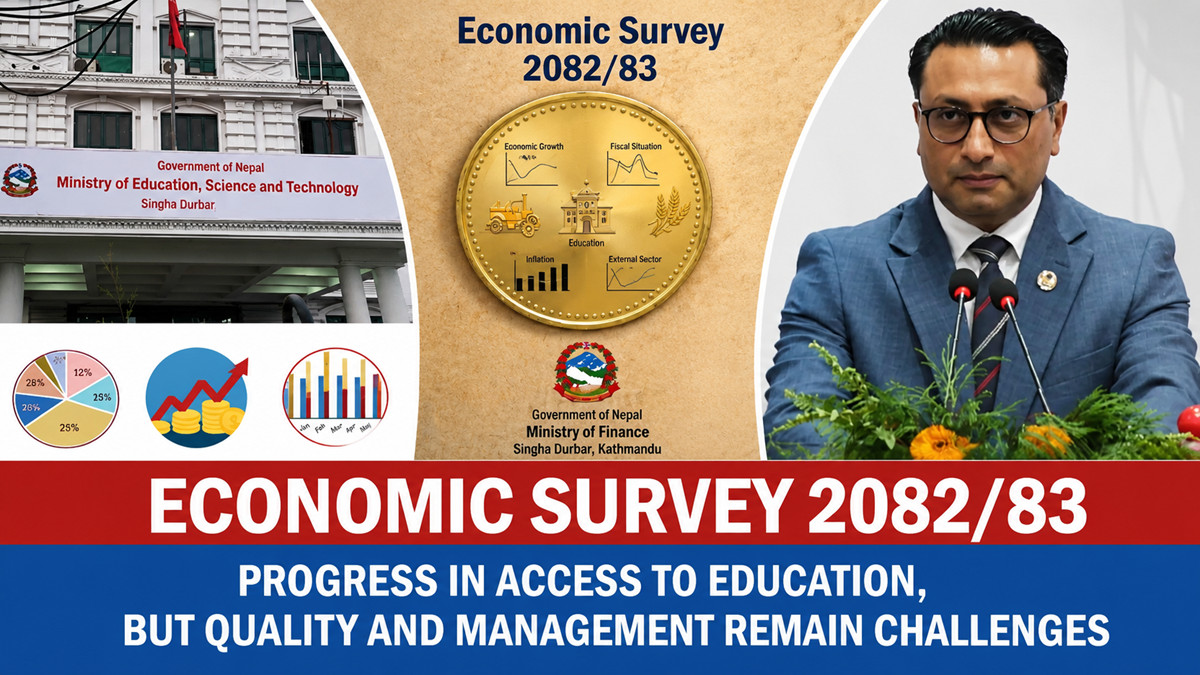
Kathmandu – Nepal’s Economic Survey 2082/83 has shown significant progress in educational access, infrastructure development, and literacy improvement in recent years. However, the report highlights that shortages of teachers in community schools continue to create serious challenges in improving educational quality and school management.
Presenting the Economic Survey at Wednesday's meeting of the House of Representatives, Finance Minister Dr. Swarnim Wagle stated that there are currently 35,951 schools operating across the country, including both public and private institutions. Among them, 71.27 percent, or 27,020 schools, are community schools, while 24.87 percent are institutional (private) schools. The remaining 3.86 percent include religious schools, Sanskrit schools, madrasas, and monasteries.
In terms of student enrollment, community schools continue to educate the majority of students. Of the total student population, 62.2 percent study in community schools, while 37.8 percent attend institutional schools.
The survey notes that there are 180,103 teachers working in community schools, while the number of students enrolled in those schools stands at approximately 4.38 million. The teacher-student ratio in community schools averages 24 students per teacher, whereas institutional schools have an average of 29 students per teacher. Gender imbalance among teachers also remains visible.
At the primary level (Grades 1–5), one teacher serves an average of 19 students. At the lower secondary level (Grades 6–8), one teacher is responsible for 33 students, while in Grades 9 and 10, one teacher serves around 23 students. Female teachers account for 49.1 percent at the basic level, but the proportion drops sharply to 22.9 percent at the secondary level.
The mismatch in teacher distribution has been identified as a major obstacle to improving educational quality. The government has recognized the need for better teacher allocation and management reforms.
Although enrollment rates at the basic level remain high, student retention at higher grades continues to be a major concern. The net enrollment rate for basic education (Grades 1–8) has reached 97.8 percent, but at the secondary level (Grades 9–12), the enrollment rate falls sharply to just 35.4 percent.
The survey identifies school dropouts, economic hardship, migration, and the growing trend of seeking employment abroad as key reasons behind the decline in secondary-level participation.
The education sector's economic contribution has also shown signs of slowing. The survey estimates that the sector's total value addition will remain at 1.50 percent this fiscal year, lower than last year's 2.36 percent. However, education is still expected to contribute 9.22 percent to the country's Gross Domestic Product (GDP).
According to the survey, 11 percent of the combined expenditure of federal, provincial, and local governments has been allocated to education. Despite continued investment, concerns remain regarding whether the spending is translating into quality educational outcomes.
Some positive improvements have been seen in academic achievement indicators. Around 66 percent of students passed the Secondary Education Examination (SEE) with grades. The proportion of non-graded students in Grade 12 has also declined from 47.85 percent last year to 38.83 percent this year.
Youth literacy has improved significantly, with the literacy rate among the 15–24 age group reaching 94.2 percent. Higher education enrollment has increased by 10.9 percent, reaching 745,770 students.
However, subject-wise imbalance in higher education remains a concern. While 50.5 percent of students are concentrated in management studies, only 0.15 percent are enrolled in agriculture education, indicating weak interest in technical and production-oriented fields.
The number of students going abroad for higher studies has slightly declined. By the end of Falgun this fiscal year, only 85,306 students had obtained No Objection Certificates (NOCs) for foreign study, which is lower compared to the same period last year.
In terms of infrastructure, internet access has expanded in community schools. Currently, 85.4 percent of community schools have internet facilities, while 29.6 percent operate IT laboratories. Around 2.7 million students at the basic level are benefiting from the midday meal program.
The government has also prioritized the management of community schools with very low student enrollment. The Ministry of Education, Science and Technology is preparing to merge or restructure nearly 15,000 schools with fewer than 100 students.
According to government data, 293 community schools have fewer than five students, despite employing four to six teachers and staff members. Similarly, there are 3,424 schools with fewer than 20 students and 5,552 schools with fewer than 30 students.
The government plans to implement school mergers and alternative management models from the next fiscal year. The problem of declining enrollment is particularly severe in hilly and Himalayan regions, where more than 10,000 low-enrollment schools are located.
Earlier, during a meeting of the parliamentary Education, Health and Information Technology Committee, Education Minister Sasmit Pokharel stated that the government’s policy is not to shut schools directly but to manage them through appropriate alternatives.
Currently, the government estimates that it spends an average of NPR 30,000 annually per student in community schools. This includes textbooks, midday meals, educational materials, and salaries for teachers and staff. At present, the government provides salaries to more than 232,000 teachers and school employees across the country.